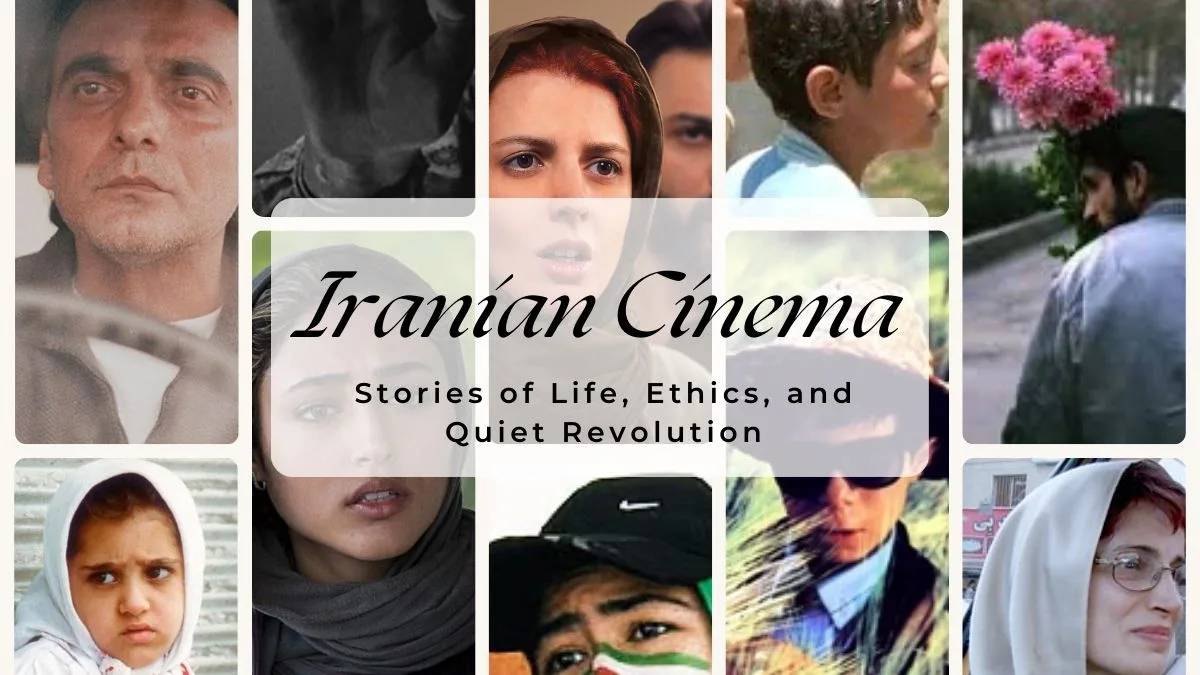
If you have ever stumbled upon Iranian cinema pieces like ‘A Separation’, ‘Children of Heaven’, or ‘Taste of Cherry’, you might have had that sudden magical moment. “Wait… this is different. This isn’t just a movie. This is whole other way of seeing the world.” There is something quiet, almost shy, yet devastatingly powerful about Iranian cinema. And the more you watch, the more you realise how these films are survived.
Low budgets, harsh censorship, secretive shoots, the constant threat of arrest. This is a world where making movies can feel like rebellion. Yet, somehow, the art thrives.
Advertisement
So why does Iranian cinema hit hard from film critics in Cannes to casual movie lovers on Netflix? The answer goes beyond censorship or poetic minimalism. It’s about trust, ethics, audacity to let viewers think for themselves.
Where to start your Iranian film journey
If you’re new to Iranian cinema, a good place to start is with its landmark films. ‘Taste of Cherry’ by Abbas Kiarostami is a meditation on life and death. His ‘Close-Up’ goes on to blur lines between reality and fiction in real-life drama.
Asghar Farhadi’s ‘About Elly’ offers some suspenseful social narrative. His ‘A Separation’ presents morally complex story. It even earned international acclaim
Majid Majidi’s ‘Children of Heaven’ tells delicate tale of sibling love. Jafar Panahi’s ‘The White Balloon’ explores honesty through the eyes of children. Panahi also provides sharp social commentary in ‘Taxi Tehran’ and confronts gender politics with humour and courage in ‘Offside’.
Majidi’s ‘The Color of Paradise’ combines innocence with visual poetry. Forough Farrokhzad’s ‘The House Is Black’ remains a documentary masterpiece.
Censorship and creativity
Iran has strict censorship rules. Politics, religion, women’s bodies, intimacy; almost everything is scrutinised. Some filmmakers get outright banned, others are forced to delete scenes. Sometimes entire movies never see the light of day.
It sounds like a nightmare, but here’s the twist.
Directors learned to speak in code. Metaphors, shadows, off-screen space, long silences. All became tools of storytelling. You learn to show much by showing little. A glance, door closing, child’s hand, subtle sound. These are all loaded with meaning.
Of course, this doesn’t mean censorship magically created great films. Many brilliant stories were lost forever. What survives is not oppression itself, but extraordinary art that grew despite it.
Realism as a moral choice, not a budget constraint
Walk onto a street in Tehran and it might feel like stepping into an Abbas Kiarostami or Majid Majidi frame. Iranian films often use real locations. Homes, villages, schools, dusty streets. Natural light is preferred. Cameras linger long enough for life to breathe.
This isn’t poverty porn. It’s honesty. Long takes, minimal edits, and slow pacing demand patience. Time is part of the story. Silence has weight. Consequences are allowed to linger. Kiarostami, one of the giants of Iranian cinema, treated each film as poetry or philosophy. Watching his film is like eavesdropping on life. Sometimes mundane, sometimes profoundly moving. Always real.
Children: Innocent guides in cinema
Step into ‘Children of Heaven’ or ‘The White Balloon’, and you’ll find children at the center. It may seem like strategy to skirt censorship. Children can touch adult issues without raising alarms. But the effect is much deeper.
Children act as moral compasses. Their innocence highlights the compromises and contradictions of adult society. They notice injustice, subtle cruelty, and everyday hypocrisy without sentimentality.
Majidi’s films, for instance, are full of kids who see the world in clear black and white. But their clarity exposes these very grey areas of adult life.
In Iranian cinema, children aren’t props. They are mirrors, ethical measuring sticks that make us reflect on our own decisions and biases.
Moral ambiguity is the star
Here’s where Iranian films become revolutionary. Forget clear-cut villains and heroes. Films like ‘A Separation’ present moral dilemmas without tidy answers. Every character is right. Every character is trapped in circumstances beyond their control.
Truth is fragmented, ethical decisions are messy. The audience is left thinking, judging, and sometimes squirming.
This is the essence of Iranian cinema: a trust in viewers’ intelligence. It doesn’t tell you what to feel or think. It trusts you to hold contradictions, to sit with uncertainty, and to wrestle with questions that may have no answers.
Even when showing poverty, social injustice, or suffering, Iranian films retain compassion. Characters are flawed, but lens is never cruel. City streets of Tehran, mountains of northern Iran, small village squares; they are inhabited by humans, not symbols.
Whether it’s the simple beauty of a child running through dusty street or a family caught in financial and moral pressure, Iranian filmmakers insist that every character is worthy of empathy.
Poetry in the DNA
Persian poetry runs through Iranian cinema like invisible river. Silence and stillness are as important as dialogue. Visual metaphor, rhythmic editing, lingering shots create cadence akin to classic Persian verse. You see, you feel.
The Iranian New Wave began in late 1960s. It combined realism, social critique, symbolism. Filmmakers like Forough Farrokhzad (‘The House is Black’) and Dariush Mehrjui pushed boundaries.
Kiarostami, with films like ‘Taste of Cherry’ and ‘Close-Up’, became a global figure praised for turning the mundane into philosophical cinema.
Jean-Luc Godard famously said, “Cinema begins with DW Griffith and ends with Abbas Kiarostami.”
Iranian films have won Oscars, Cannes, Venice, and Berlin awards. ‘A Separation’ made headlines worldwide. But global recognition also shaped expectations. The world began to anticipate slow, rural, symbolic films.
Some directors leaned into this aesthetic consciously. Yet real Iranian cinema is diverse. Urban dramas, comedies, thrillers, and politically charged works exist. They just don’t always get the international spotlight.
Women fighting through the frame
Behind the camera, Iranian women filmmakers are carving paths under immense pressure. Samira Makhmalbaf and Rakhshan Bani-Etemad are names you’ll hear in international film circles, celebrated for their courage and subtlety. Their films question class, gender, power without ever feeling preachy. Every frame is a quiet act of defiance.
Women’s perspectives have broadened Iranian cinema. They have added layers of social critique and humanity that are rarely seen in mainstream global cinema.
The underground spirit
Not all Iranian films see theaters. Some are made in secret, sometimes smuggled to international festivals. Low budgets, guerrilla-style filming, tiny crews, risky locations produce unique intimacy. You feel the presence of the filmmaker in every shot. Risk and resourcefulness fuel innovation, creating cinema that feels alive, immediate, personal.
It’s almost like an exclusive club. If you know, you know. And films that survive the system emerge sharper, richer, more daring.
Why Iranian cinema matters
Iranian cinema shows that spectacle isn’t everything. You don’t need CGI or explosions to create profound emotion. Its genius lies in moral uncertainty, trust in the audience, humanity’s complexity. It shows us that sometimes what you don’t see is as powerful as what you do.
Filmmakers who can’t show everything learn to mean everything. A glance becomes a confession. A child’s question becomes moral challenge. Silence carries more weight than dialogues.
This is why Iranian cinema continues to matter. And once you step inside this world, you realise there’s no turning back.